Twelve Big Blinds and a Dream
Short stacks are the easiest stacks to play well. The simple jam-or-fold map, and why you're folding too much in the big blind.
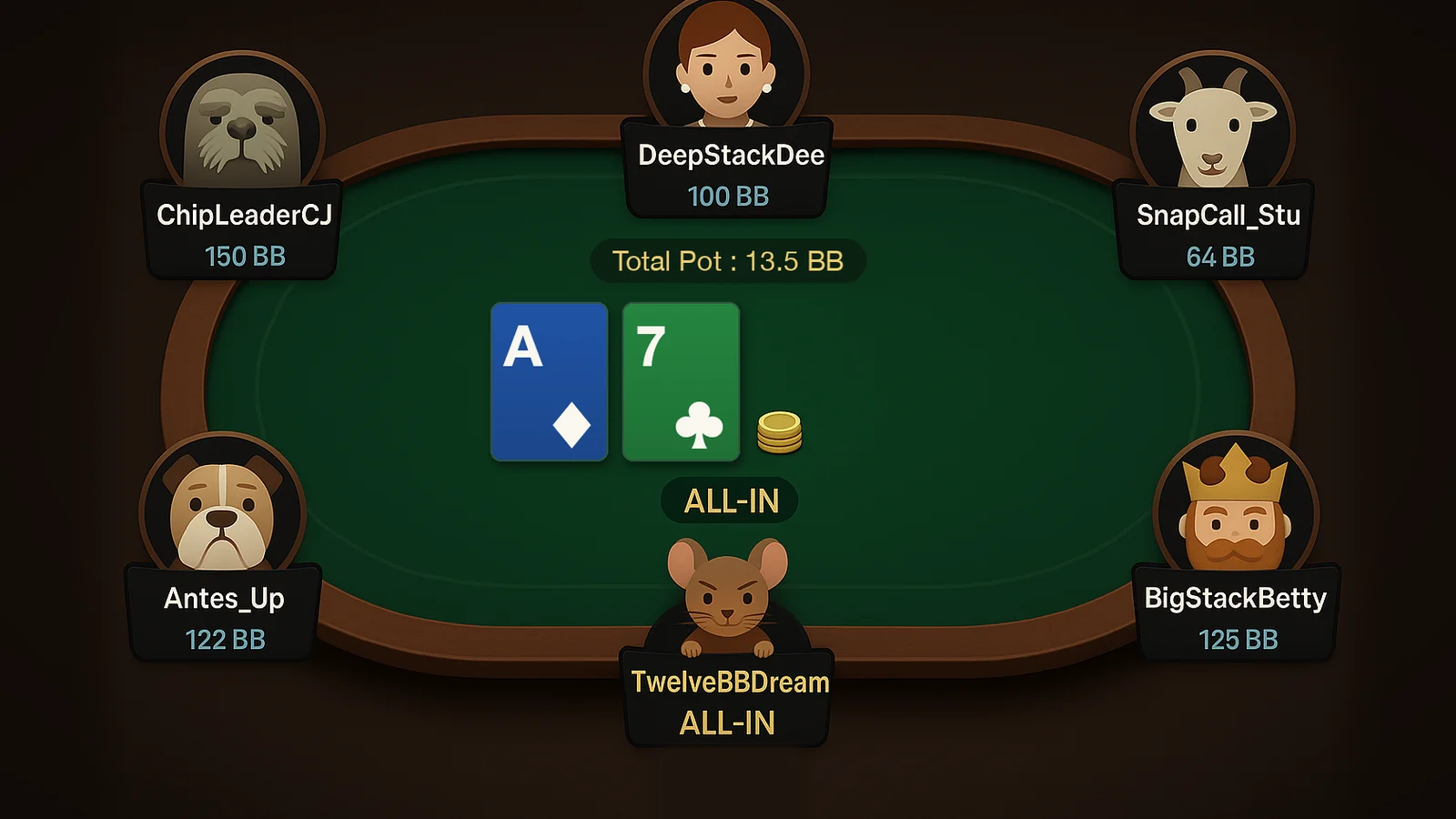
There's a special kind of dread that comes with looking down at your stack and doing the maths. Twelve big blinds. The antes are biting, the clock is ticking, and you haven't seen a playable hand since the dinner break.
Relax. Short stacks are actually the simplest stacks to play well. The decision tree gets small, and small trees are easy to learn.
The basic map
Here's a clean framework that's worth memorising:
- 20–25bb: min-raise when you open. 3-bet to about 2.5–3x in position, 3.5x out of position, or just shove. Any 4-bet is all-in.
- 10–19bb: min-raise first in, and jam over anyone else's raise.
- 9bb or less: jam first in. No more min-raising.
That's it. That's the skeleton. Everything else is filling in which hands go where.
Facing an open at 10bb
Someone opens and you've got 10bb. The rule: jam or fold. Be very tight against early-position opens and much looser against late ones. Only the big blind gets to flat much, because they're already invested and closing the action.
Calling jams: wider than you think
Here's where live players leak the most. They fold the big blind against a jam with hands that are easy calls.
GTO Wizard has the big blind at 20bb calling a small blind open-jam (chip EV) with 23.5% of hands: every pair, A-5 offsuit and better, A-3 suited and better, K-J offsuit and better, K-9 suited and better, and T-9 suited.
At 10bb, the big blind should call a button jam with about 31% of hands. At 5bb, it's about 55%. You're getting a price, and the jammer's range is wide. Take the price.
Don't make it complicated
The worst thing you can do at 12bb is something fancy. Limp-calling, min-raise folding your good hands, flatting and folding the flop. All of that leaks chips you can't afford.
Pick a lane: jam, min-raise with a plan, or fold. Know which hands go where before you sit down.
One honest caveat
These ranges are for normal chip-EV spots. On the bubble or at a final table, ICM tightens your calls a lot. If you're short and covered by a big stack on the stone bubble, the big blind call gets much narrower.
Twelve big blinds isn't a death sentence. A double-up puts you at 25, and from there you've got a tournament again.