Blind vs Blind: The Street Fight Nobody Teaches
Folded to the small blind? Ranges get wide, bets get small, and nobody's backing down. How to stop bleeding chips in the most common spot in poker.
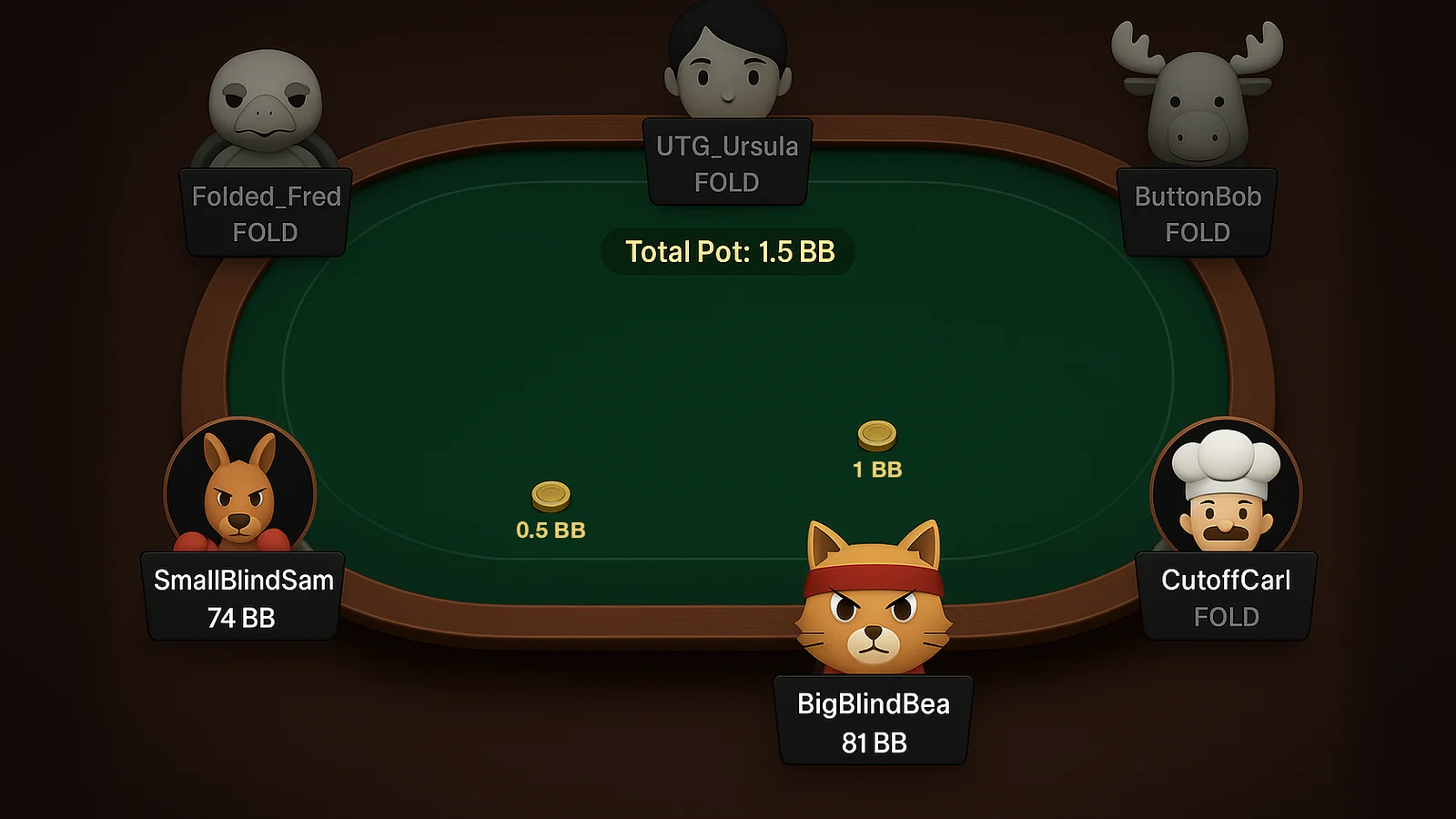
Everyone folds to the small blind. It's just you and the big blind, a couple of chips in the middle, and the kind of tension you normally only see at a family Christmas.
Blind versus blind is the most played spot in poker that nobody studies. Ranges are wide, egos are big and a lot of chips change hands. Here's how to stop losing them.
Forget your full-ring hand values
When the small blind opens, it's opening a huge range. When the big blind defends, it's defending an even bigger one. K-6 suited is a solid hand here. J-8 suited is a defend. A-9 offsuit is a monster compared with what you'd see from an under-the-gun open.
If you play blind versus blind with the same hand values you'd use against an early-position raiser, you'll fold your way out of the tournament.
The A-9-5 example
Run this one through GTO Wizard: small blind opens, big blind calls, flop comes . The small blind's strategy looked like this:
- 69% of hands → bet 23% pot
- 24% of hands → bet 68% pot
- 7% of hands → check
That's a tiny bet with almost everything. The small blind has more strong aces, so it just keeps poking.
The big blind, facing that small bet, folds only about 32% of the time. It floats backdoor hands like and and raises some weak aces. Both players are fighting over a small pot, and neither is giving up easily.
Board texture still runs the show
The other rule here: the small blind should c-bet by texture. Rainbow boards get bet the most. Monotone boards like get bet the least, because neither player has a clear edge there and the out-of-position raiser gets punished for betting too much.
A little exploit to keep in your pocket
One GTO Wizard coach shows that if the small blind just range-bets 25% pot on boards like (lots of players do this live), the big blind should raise about twice as often as normal, to around 50% pot, and fold less. That small bet is getting through way too often, so make it expensive. That's an exploit, so save it for players you've actually seen doing it.
The short version
Widen your ranges, bet small on boards that favour you, and don't let a small c-bet push you off a pot you'd defend anywhere else. Blind battles are where tournaments are quietly won and lost.